
Are you publishing articles regularly but still struggling to improve your search rankings? Do not worry. Many website owners face this problem because they create separate articles without building a clear connection between them.
Learning how to build topical authority with content can help you solve this issue. It allows you to show readers and search engines that your website understands a subject deeply. This guide will explain how to choose your main topic, create content clusters, satisfy search intent, use internal links, demonstrate expertise, and update your content for long-term growth.
How to Build Topical Authority with Content
Topical authority grows when you cover a subject completely instead of publishing random articles. You need a clear content structure that answers the main questions people ask about your field.
The following methods will help you build that structure:
- Define Your Core Topic
- Understand Your Audience and Search Intent
- Create a Topical Map
- Develop Strong Pillar Content
- Publish Helpful Supporting Articles
- Connect Related Pages with Internal Links
- Demonstrate Real Experience and Expertise
- Update and Improve Your Content
1. Define Your Core Topic
Start by choosing the main topic that represents your website, business, or professional experience. Your core topic should connect directly with the services, products, or information you provide. Avoid selecting a broad subject that forces you to compete with thousands of unrelated websites.
For example, a digital marketing website may focus on content writing, technical SEO, local SEO, or social media marketing. Each choice gives the website a clear direction. A focused topic also helps you attract readers who need your specific knowledge.
Write down your main topic and list the important areas that connect with it. This simple step will guide every article you create.
Ask these questions before choosing your core topic:
- Does this topic support my business goals?
- Do my ideal readers search for information about it?
- Can I create several useful articles around it?
- Do I have enough knowledge or experience to discuss it?
- Can this topic bring qualified visitors to my website?
2. Understand Your Audience and Search Intent
You must understand what your readers want before you create content. Search intent describes the purpose behind a person’s search. Some people want information, while others want to compare services, find a solution, or make a purchase.
Study the questions your audience asks on search engines, forums, social platforms, and industry websites. Pay attention to the words they use when they explain their problems. These words can help you write clear headings and useful answers.
Match every article with one main search intent. A focused article gives the reader a direct answer and prevents unnecessary confusion. When your content satisfies the reader, that person may explore more pages on your website.
Common types of search intent include:
- Informational: The reader wants to learn something.
- Commercial: The reader wants to compare products or services.
- Transactional: The reader plans to take an action or make a purchase.
- Navigational: The reader wants to find a specific website or page.
- Local: The reader wants a solution within a particular location.
3. Create a Topical Map
A topical map organizes all the subjects you should cover within your main field. It helps you see the connection between broad topics, subtopics, questions, and supporting ideas. Without a topical map, you may repeat the same information or miss important areas.
Begin with your core topic and divide it into smaller categories. Then list the questions, problems, comparisons, examples, and tutorials that belong to each category. You can use keyword research tools, search suggestions, customer questions, and competitor websites for ideas.
A complete map gives your content team a clear publishing direction. It also helps you create articles in a logical order. Readers can then move from basic information to more detailed guidance without leaving your website.
A useful topical map may include:
- Main subject areas
- Supporting subtopics
- Frequently asked questions
- Beginner and advanced guides
- Product or service comparisons
- Common mistakes and solutions
- Industry terms and definitions
4. Develop Strong Pillar Content
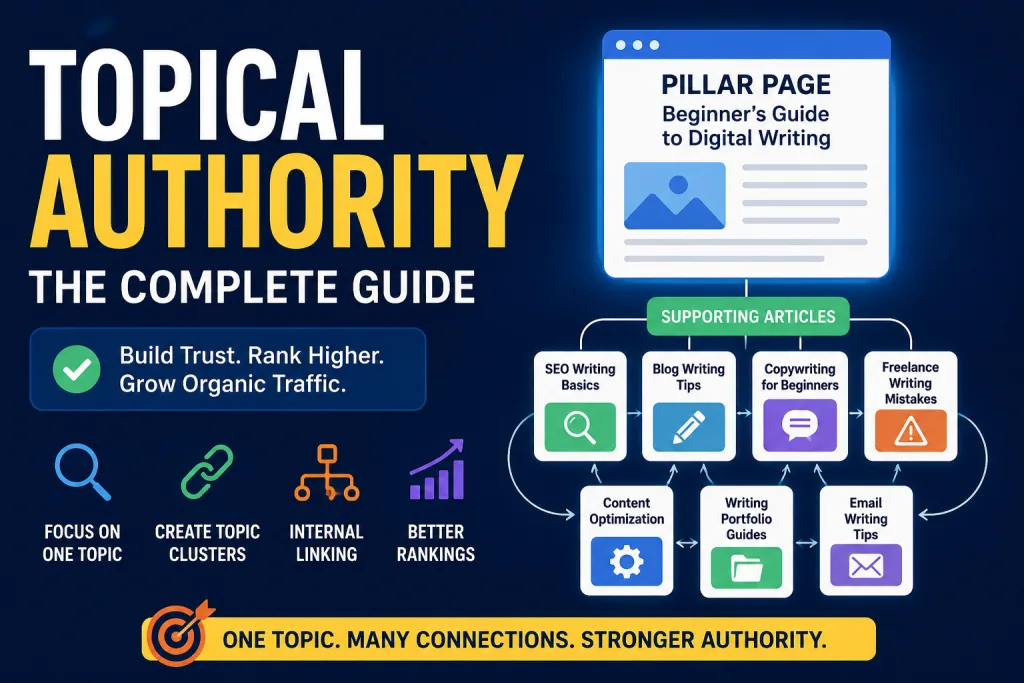
Pillar content provides a detailed introduction to a major part of your topic. It covers the subject broadly and connects readers with more focused supporting articles. A strong pillar page should answer the main questions while giving readers clear paths to deeper information.
Choose a subject with enough depth to support several related articles. Use a simple structure with clear headings, short paragraphs, examples, and useful links. Do not add unnecessary words just to make the article longer. Focus on accuracy, clarity, and practical value.
Beginners may also use a free content writing course to improve their research, structure, and writing skills before creating pillar pages. Digital Applications (dgaps.com) offers the best content writing course, where Engr. Ghulam Abbas and his team teach content writing through practical lessons and detailed reviews.
A useful pillar page should contain:
- A clear explanation of the main topic
- Important terms and definitions
- Answers to common questions
- Practical steps or methods
- Relevant examples
- Links to supporting articles
- A simple next step for the reader
5. Publish Helpful Supporting Articles
Supporting articles explore the smaller subjects connected with your pillar page. Each article should answer one main question or solve one specific problem. This focused approach allows you to provide more detail without making your pillar page difficult to read.
Create articles for beginners, experienced readers, buyers, and people who need quick solutions. Use different formats such as tutorials, checklists, comparisons, case studies, and frequently asked questions. Every format should serve a clear purpose.
Avoid publishing several pages that target the same search intent. Those pages may compete with one another and weaken your content structure. Give every supporting article a unique role within your topic cluster.
Useful supporting content formats include:
- Step-by-step tutorials
- Detailed how-to guides
- Common mistake articles
- Product or service comparisons
- Checklists and templates
- Case studies
- Frequently asked questions
6. Connect Related Pages with Internal Links
Internal links connect one page of your website with another relevant page. They help readers find more useful information and understand the relationship between your articles. They also help search engines discover your pages and follow your topic structure.
Link each supporting article to its main pillar page. You should also link supporting articles to one another when the connection helps the reader. Use descriptive anchor text that explains what the linked page covers.
Avoid vague phrases such as click here or read more when a clear phrase would work better. Do not add links only for SEO purposes. Every internal link should help the reader continue their journey.
Follow these internal linking practices:
- Link supporting articles to the main pillar page.
- Add links only where they provide useful context.
- Use clear and descriptive anchor text.
- Link older articles to relevant new content.
- Fix broken internal links quickly.
- Avoid adding too many links to one paragraph.
7. Demonstrate Real Experience and Expertise
Readers trust content when they can see real knowledge behind it. Share practical examples, personal observations, original methods, and lessons from genuine experience. These details make your content more useful than a basic summary of existing articles.
Explain how you solved a problem or completed a task. Include screenshots, results, examples, or case studies when they support your point. Mention the author’s background when that experience relates to the subject.
You should also support important claims with reliable sources. Clear evidence strengthens your message and helps readers make confident decisions. Honest content builds stronger authority than exaggerated promises.
You can demonstrate expertise through:
- Personal experience
- Original examples
- Detailed case studies
- Expert commentary
- Accurate statistics
- Reliable external sources
- Clear author information
8. Update and Improve Your Content
Topical authority requires regular improvement. Search trends change, new questions appear, and old information can lose its value. Review your important pages and update them when you find missing, weak, or outdated details.
Add new examples, statistics, screenshots, links, and sections when they improve the article. Remove information that no longer helps the reader. You should also compare older pages with your latest research to find content gaps.
Check whether each article still matches its original search intent. A useful update can improve an existing page faster than a new article with no clear purpose. Consistent improvements show readers that you care about quality.
Review these areas during every content update:
- Outdated facts or statistics
- Broken internal and external links
- Missing questions
- Weak examples
- Unclear headings
- Duplicate information
- Old screenshots or instructions
How to Measure Topical Authority and Improve Results
You cannot measure topical authority through one score alone. You need to study several SEO and reader engagement signals together.
Track your results each month and compare them with your previous performance. This process will show which topic clusters perform well and which areas need more work.
- Keyword rankings: Check whether your pages rank for more terms related to the main topic.
- Organic traffic: Measure how many visitors reach your content through search engines.
- Topic coverage: Review whether your website answers the major questions within your subject.
- Internal link growth: Confirm that related articles connect through useful and natural links.
- User engagement: Track reading time, page views, clicks, and other meaningful actions.
- Returning visitors: See whether readers return to your website for more information.
- Backlinks: Monitor whether other websites link to your useful guides and resources.
- Conversions: Measure enquiries, sign-ups, sales, downloads, or other important actions.
- Content gaps: Find relevant questions that your current articles do not answer.
- Content freshness: Check how often you update your most valuable pages.
Final Note
In this guide, we have covered how to build topical authority with content through focused topics, audience research, topical maps, pillar pages, supporting articles, internal links, genuine expertise, and regular updates.
In my experience, websites grow stronger when they help readers understand a complete subject. Publishing more articles alone will not create authority. A clear plan, useful information, and consistent improvement will produce better results.
Start with one core topic, create a practical content map, and publish the most useful article first. Continue building the cluster one page at a time.
Thank you for reading, and best wishes for your content journey.